Loan Officers in Vermont
Thinking about a career as a Loan Officers in Vermont? Here’s what the data says. Evaluate, authorize, or recommend approval of commercial, real estate, or credit loans. Advise borrowers on financial status and payment methods. Includes mortgage loan officers and agents, collection analysts, loan servicing officers, loan underwriters, and payday loan officers.
What do Loan Officers Make in Vermont?
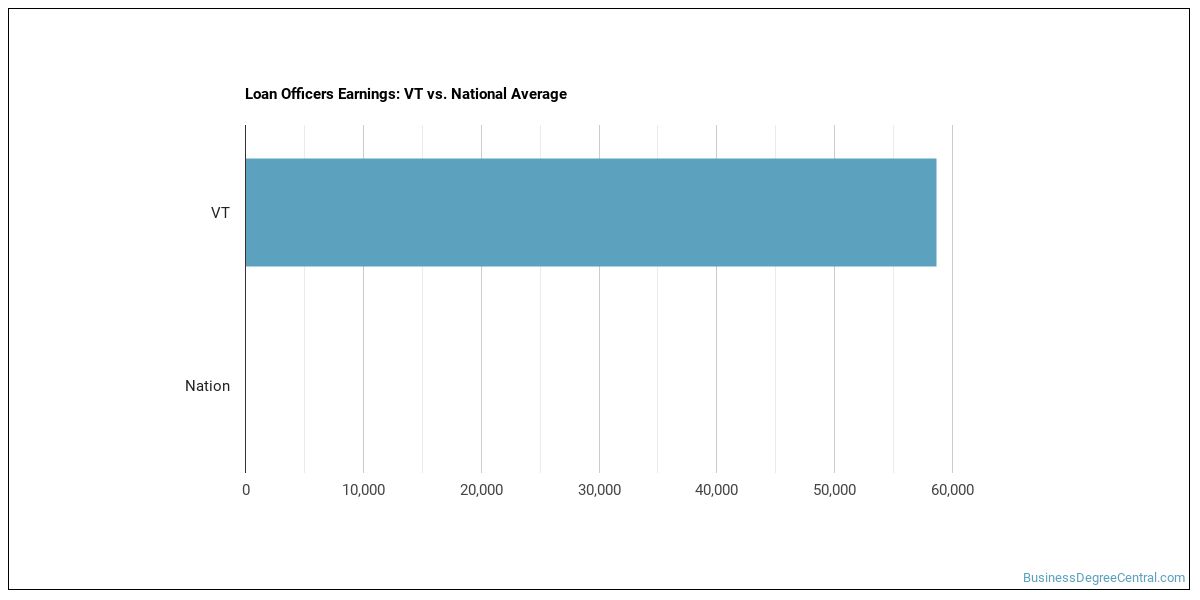
For a loan officers working in Vermont, wages run about $86,490 per year (or roughly $41.58/hour).Annual wages span from $50,930 at the 10th percentile to $164,790 at the 90th percentile.
| Wage Statistic | Annual | Hourly |
|---|---|---|
| 10th percentile | $50,930 | $24.49 |
| 25th percentile | $62,690 | $30.14 |
| Median (50th) | $86,490 | $41.58 |
| 75th percentile | $127,190 | $61.15 |
| 90th percentile | $164,790 | $79.23 |

The job concentration index in Vermont nationwide is 0.76, meaning fewer loan officers per worker than the national average.
National Wage Comparison
Nationally, loan officers earn a median of $79,088 per year ($38.02/hour), exceeding the Vermont median.
Employment Outlook
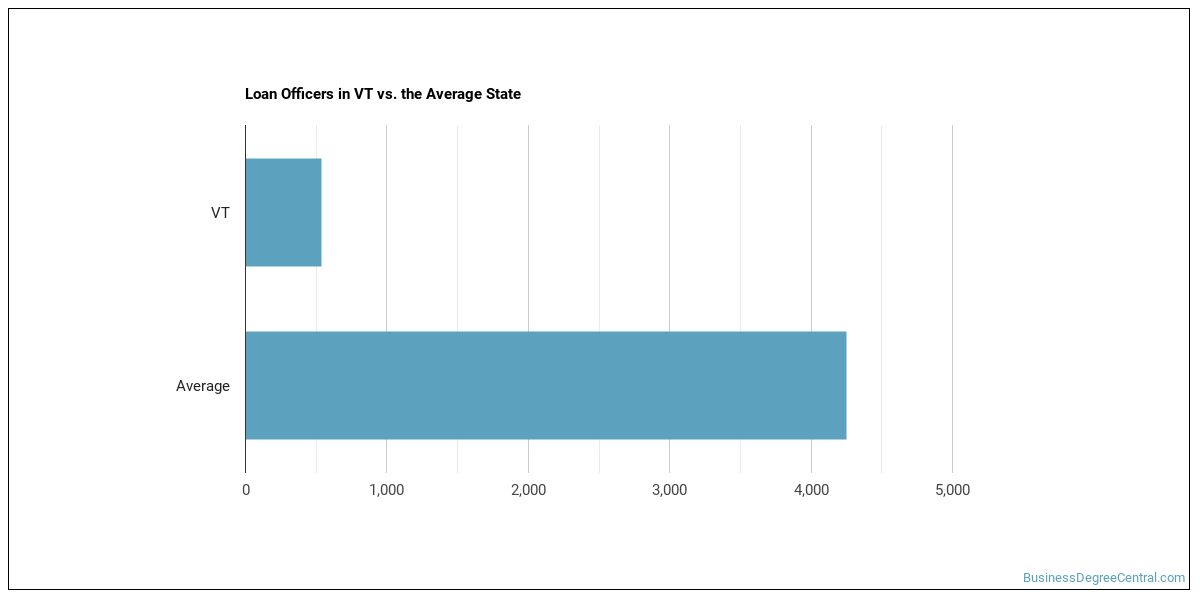
Nationally, total employment in this occupation is 299,565 loan officers in the U.S.. In Vermont alone, about 440 people work in this role. That’s fewer than the typical state, which employs around 3,990 loan officers.

Top Vermont Metros for Loan Officers
These are the Vermont metros with the most loan officers in Vermont.
| Metro Area | Number Employed | Annual Median Salary |
|---|---|---|
| Burlington-South Burlington, VT | 170 | $79,120 |
Top States for Loan Officers Employment
View the states that employ the most loan officers work.
| State | Number Employed |
|---|---|
| California | 27,420 |
| Texas | 24,070 |
| Florida | 19,750 |
| North Carolina | 11,890 |
| New York | 11,850 |
| Arizona | 11,420 |
| Michigan | 10,910 |
| Ohio | 10,340 |
| Illinois | 10,330 |
| Georgia | 9,480 |
| Virginia | 9,170 |
| Pennsylvania | 8,820 |
| Tennessee | 7,610 |
| Missouri | 7,000 |
| Minnesota | 6,950 |
| Washington | 6,480 |
| New Jersey | 5,690 |
| Alabama | 5,680 |
| Utah | 5,590 |
| Wisconsin | 5,020 |
Highest-Paying States for Loan Officers
Where loan officers earn the most: loan officers.
| State | Annual Median Salary |
|---|---|
| District of Columbia | $102,200 |
| New York | $98,940 |
| New Jersey | $95,090 |
| Massachusetts | $93,430 |
| Vermont | $86,490 |
| Minnesota | $84,480 |
| North Dakota | $82,990 |
| Kansas | $82,540 |
| Delaware | $80,760 |
| Iowa | $80,070 |
Skills
The most important loan officers skills, rated on an importance scale of 0 to 5:
Knowledge Areas
Core knowledge areas for this occupation, rated on an importance scale of 0 to 5:
Abilities
Top abilities for loan officers, rated on an importance scale of 0 to 5:
Daily Tasks
Loan Officers typically:
- Meet with applicants to obtain information for loan applications and to answer questions about the process.
- Analyze applicants' financial status, credit, and property evaluations to determine feasibility of granting loans.
- Approve loans within specified limits, and refer loan applications outside those limits to management for approval.
- Explain to customers the different types of loans and credit options that are available, as well as the terms of those services.
- Submit applications to credit analysts for verification and recommendation.
- Review loan agreements to ensure that they are complete and accurate according to policy.
- Review and update credit and loan files.
- Obtain and compile copies of loan applicants' credit histories, corporate financial statements, and other financial information.
- Work with clients to identify their financial goals and to find ways of reaching those goals.
- Handle customer complaints and take appropriate action to resolve them.
- Stay abreast of new types of loans and other financial services and products to better meet customers' needs.
- Market bank products to individuals and firms, promoting bank services that may meet customers' needs.
Work Activities
- Getting Information
- Evaluating Information to Determine Compliance with Standards
- Establishing and Maintaining Interpersonal Relationships
- Processing Information
- Analyzing Data or Information
- Working with Computers
- Communicating with People Outside the Organization
- Making Decisions and Solving Problems
- Communicating with Supervisors, Peers, or Subordinates
- Organizing, Planning, and Prioritizing Work
- Updating and Using Relevant Knowledge
- Documenting/Recording Information
Tools & Technology
Common tools and software used in this occupation include: Hot technologies: Microsoft Access, Microsoft Excel In-demand technologies: Microsoft Excel
What Major Will Prepare You For This Career?
Programs that train for this career include:
- Finance & Financial Management
Featured schools near , edit
Related Careers
Careers similar to loan officers include:
- Financial Managers
- Accountants and Auditors
- Credit Analysts
- Financial and Investment Analysts
- Personal Financial Advisors
- Insurance Underwriters
Also Known As
Agricultural Loan Officer, Bank Officer, Bank Representative, Banking Services Officer, Branch Banker, Branch Lending Officer, Business Banker, Business Banking Officer, Commercial Banker, Commercial Lender, Commercial Loan Collection Officer, Commercial Loan Officer, Commercial Mortgage Broker, Commercial Relationship Manager, Consumer Lending Specialist.
References
- U.S. Bureau of Labor Statistics, Occupational Employment and Wage Statistics — https://www.bls.gov/oes/
- O*NET Online — https://www.onetonline.org/
- BLS Employment Projections — https://www.bls.gov/emp/
- O*NET-SOC code: 13-2072.00

BusinessDegreeCentral.com provides higher-education, college and university, degree, program, career, salary, and other helpful information to students, faculty, institutions, and other internet audiences. Presented information and data are subject to change. Inclusion on this website does not imply or represent a direct relationship with the company, school, or brand. Information, though believed correct at time of publication, may not be correct, and no warranty is provided. Contact the schools to verify any information before relying on it. Financial aid may be available for those who qualify. The displayed options may include sponsored or recommended results, not necessarily based on your preferences.
© BusinessDegreeCentral.com – All Rights Reserved.