Personal Financial Advisors in North Carolina
Considering working as a Personal Financial Advisors in North Carolina? Here’s what you need to know. Advise clients on financial plans using knowledge of tax and investment strategies, securities, insurance, pension plans, and real estate. Duties include assessing clients' assets, liabilities, cash flow, insurance coverage, tax status, and financial objectives. May also buy and sell financial assets for clients. Excludes “Securities, Commodities, and Financial Services Sales Agents” (41-3031).
What do Personal Financial Advisors Make in North Carolina?
We don’t have state-specific wage data for this career in North Carolina. See the national figures below.
National Wage Comparison
Nationally, personal financial advisors earn a median of $91,777 per year ($44.12/hour).
Employment Outlook
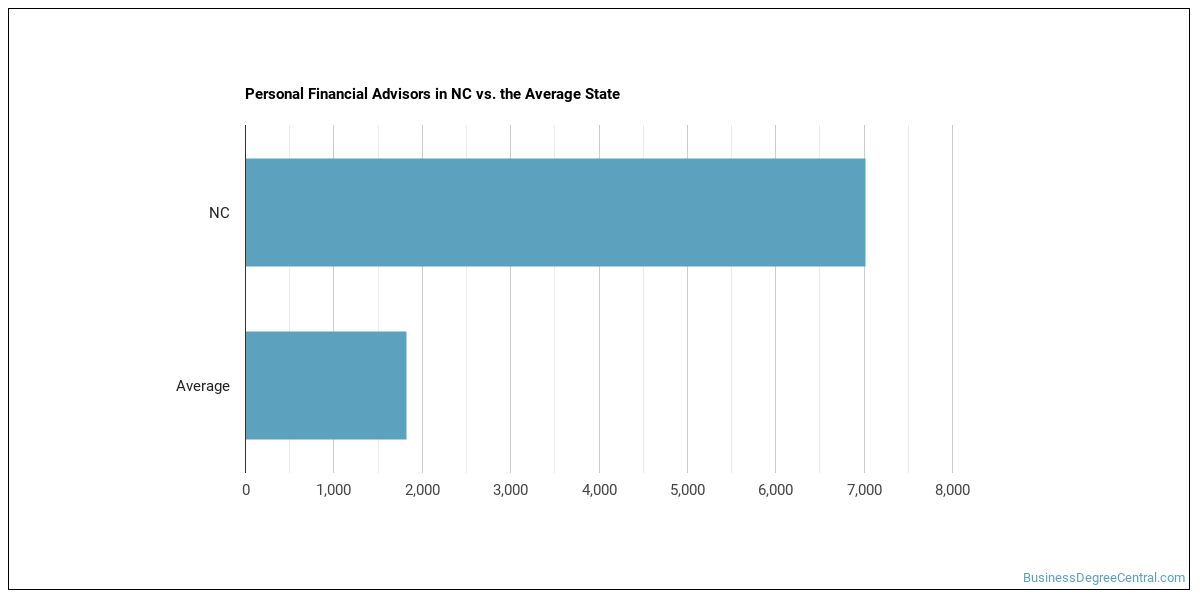
There are roughly 291,292 personal financial advisors across the United States. In North Carolina alone, around 12,850 people work in this role. That’s more than the typical state, which employs around 2,400 personal financial advisors.

Top North Carolina Metros for Personal Financial Advisors
These are the North Carolina metros with the most personal financial advisors in North Carolina.
| Metro Area | Number Employed | Annual Median Salary |
|---|---|---|
| Charlotte-Concord-Gastonia, NC-SC | 5,420 | n/a |
| Raleigh-Cary, NC | 1,910 | $106,470 |
| Durham-Chapel Hill, NC | 1,810 | $61,530 |
| Winston-Salem, NC | 640 | $129,570 |
| Greensboro-High Point, NC | 540 | $108,130 |
| Asheville, NC | 360 | $117,730 |
| Wilmington, NC | 310 | $106,960 |
| Fayetteville, NC | 120 | $117,610 |
| Greenville, NC | 60 | $81,000 |
| Hickory-Lenoir-Morganton, NC | 60 | n/a |
| Pinehurst-Southern Pines, NC | 60 | $155,950 |
| Rocky Mount, NC | 60 | $99,100 |
| Burlington, NC | 40 | $104,640 |
Top States for Personal Financial Advisors Employment
The table below shows the states where the most personal financial advisors work.
| State | Number Employed |
|---|---|
| California | 34,070 |
| New York | 28,820 |
| Florida | 21,230 |
| Texas | 17,570 |
| North Carolina | 12,850 |
| Pennsylvania | 12,370 |
| Illinois | 10,410 |
| Ohio | 10,210 |
| Georgia | 7,540 |
| Massachusetts | 7,410 |
| Arizona | 7,190 |
| New Jersey | 6,830 |
| Washington | 6,510 |
| Minnesota | 6,360 |
| Michigan | 6,030 |
| Colorado | 5,930 |
| Maryland | 5,560 |
| Virginia | 5,560 |
| Indiana | 5,370 |
| Wisconsin | 5,240 |
Highest-Paying States for Personal Financial Advisors
These states pay the most for personal financial advisors.
| State | Annual Median Salary |
|---|---|
| New York | $167,970 |
| Idaho | $136,440 |
| California | $128,650 |
| Delaware | $128,170 |
| New Jersey | $123,690 |
| South Dakota | $123,380 |
| Maryland | $122,510 |
| Wisconsin | $115,680 |
| Washington | $112,020 |
| Connecticut | $107,030 |
Skills
Top personal financial advisors skills, rated on an importance scale of 0 to 5:
Knowledge Areas
Key knowledge areas for this occupation, rated on an importance scale of 0 to 5:
Abilities
Key abilities for personal financial advisors, rated on an importance scale of 0 to 5:
Daily Tasks
Day-to-day, personal financial advisors typically:
- Interview clients to determine their current income, expenses, insurance coverage, tax status, financial objectives, risk tolerance, or other information needed to develop a financial plan.
- Analyze financial information obtained from clients to determine strategies for meeting clients' financial objectives.
- Answer clients' questions about the purposes and details of financial plans and strategies.
- Review clients' accounts and plans regularly to determine whether life changes, economic changes, environmental concerns, or financial performance indicate a need for plan reassessment.
- Manage client portfolios, keeping client plans up-to-date.
- Recommend to clients strategies in cash management, insurance coverage, investment planning, or other areas to help them achieve their financial goals.
- Recommend financial products, such as stocks, bonds, mutual funds, or insurance.
- Implement financial planning recommendations, or refer clients to someone who can assist them with plan implementation.
- Contact clients periodically to determine any changes in their financial status.
- Prepare or interpret for clients information, such as investment performance reports, financial document summaries, or income projections.
- Explain to clients the personal financial advisor's responsibilities and the types of services to be provided.
- Investigate available investment opportunities to determine compatibility with client financial plans.
Work Activities
- Getting Information
- Analyzing Data or Information
- Working with Computers
- Making Decisions and Solving Problems
- Establishing and Maintaining Interpersonal Relationships
- Updating and Using Relevant Knowledge
- Processing Information
- Interpreting the Meaning of Information for Others
- Communicating with People Outside the Organization
- Organizing, Planning, and Prioritizing Work
- Documenting/Recording Information
- Providing Consultation and Advice to Others
Tools & Technology
Common tools and software used in this occupation include: Hot technologies: Microsoft Access, Microsoft Excel In-demand technologies: Microsoft Excel
What Major Will Prepare You For This Career?
Programs that train for this career include:
- Finance & Financial Management
Featured schools near , edit
Related Careers
Other careers like personal financial advisors include:
- Financial Managers
- Treasurers and Controllers
- Investment Fund Managers
- Management Analysts
- Accountants and Auditors
- Budget Analysts
Also Known As
Account Manager, Asset Analyst, Asset Manager, Budget Counselor, Certified Financial Planner (CFP), Chartered Financial Analyst (CFA), Client Advisor, Credit Counselor, Debt Counselor, Estate Planner, Estate Planning Counselor, Estate Trustee, Finance Consultant, Financial Advisor, Financial Advisor Associate.
References
- U.S. Bureau of Labor Statistics, Occupational Employment and Wage Statistics — https://www.bls.gov/oes/
- O*NET Online — https://www.onetonline.org/
- BLS Employment Projections — https://www.bls.gov/emp/
- O*NET-SOC code: 13-2052.00

BusinessDegreeCentral.com provides higher-education, college and university, degree, program, career, salary, and other helpful information to students, faculty, institutions, and other internet audiences. Presented information and data are subject to change. Inclusion on this website does not imply or represent a direct relationship with the company, school, or brand. Information, though believed correct at time of publication, may not be correct, and no warranty is provided. Contact the schools to verify any information before relying on it. Financial aid may be available for those who qualify. The displayed options may include sponsored or recommended results, not necessarily based on your preferences.
© BusinessDegreeCentral.com – All Rights Reserved.