Economists in Georgia
Thinking about a career as an Economists in Georgia? Here’s what the data says. Conduct research, prepare reports, or formulate plans to address economic problems related to the production and distribution of goods and services or monetary and fiscal policy. May collect and process economic and statistical data using sampling techniques and econometric methods. Excludes “Market Research Analysts and Marketing Specialists” (13-1161).
What do Economists Make in Georgia?
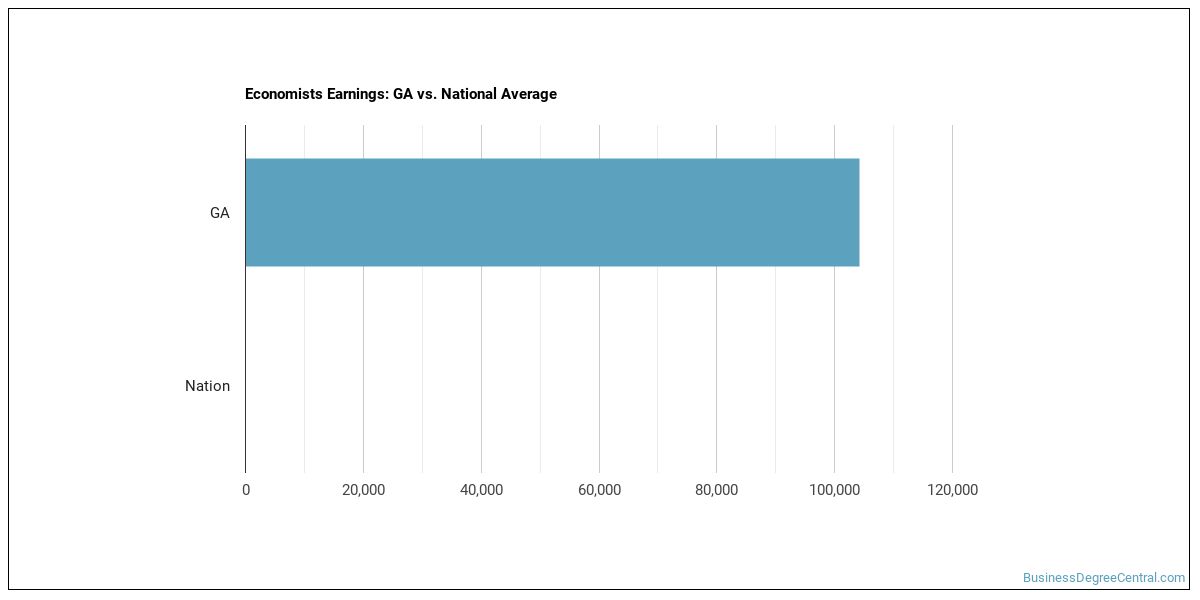
For a economists working in Georgia, wages run about $127,220 per year (or roughly $61.17/hour).Earnings range from $81,630 at the 10th percentile to $222,120 at the 90th percentile.
| Wage Statistic | Annual | Hourly |
|---|---|---|
| 10th percentile | $81,630 | $39.24 |
| 25th percentile | $109,260 | $52.53 |
| Median (50th) | $127,220 | $61.17 |
| 75th percentile | $167,860 | $80.70 |
| 90th percentile | $222,120 | $106.79 |

Location quotient — how concentrated this career is in Georgia compared to the national average — is 0.68, suggesting fewer economists per worker than the national average.
National Wage Comparison
Nationally, economists earn a median of $73,611 per year ($35.39/hour), above the Georgia median.
Employment Outlook
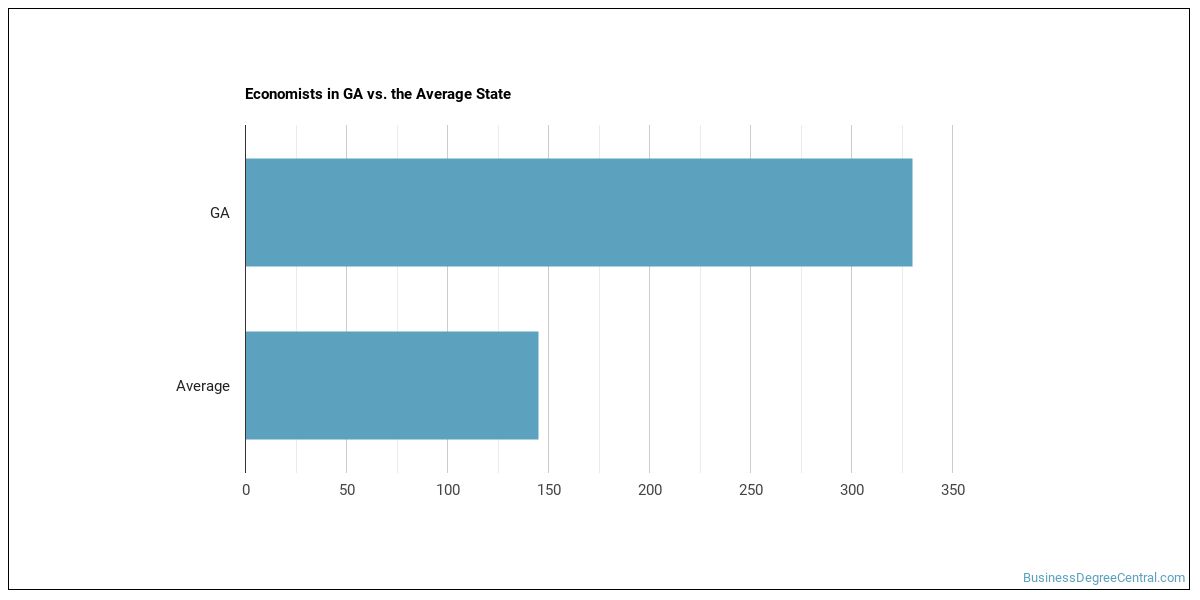
There are roughly 34,480 economists across the United States. In Georgia alone, approximately 340 people work in this role. That’s higher than the typical state, which employs around 210 economists.

Top Georgia Metros for Economists
The metro areas below employ the most economists in Georgia.
| Metro Area | Number Employed | Annual Median Salary |
|---|---|---|
| Atlanta-Sandy Springs-Roswell, GA | 310 | $127,220 |
Top States for Economists Employment
The table below shows the states where the most economists work.
| State | Number Employed |
|---|---|
| District of Columbia | 3,010 |
| California | 1,400 |
| Virginia | 970 |
| Maryland | 920 |
| New York | 870 |
| Massachusetts | 770 |
| Pennsylvania | 710 |
| South Carolina | 660 |
| Texas | 620 |
| Illinois | 590 |
| Washington | 470 |
| Florida | 460 |
| Georgia | 340 |
| Wisconsin | 330 |
| Michigan | 280 |
| Oregon | 270 |
| North Carolina | 250 |
| Colorado | 230 |
| Minnesota | 210 |
| Missouri | 210 |
Highest-Paying States for Economists
The highest-paying states for economists.
| State | Annual Median Salary |
|---|---|
| District of Columbia | $162,610 |
| Virginia | $148,010 |
| New York | $142,300 |
| Maryland | $137,610 |
| Georgia | $127,220 |
| Ohio | $117,750 |
| Washington | $116,390 |
| Missouri | $115,520 |
| Kansas | $115,100 |
| Pennsylvania | $113,300 |
Skills
Top economists skills, rated on an importance scale of 0 to 5:
Knowledge Areas
Key knowledge areas for this occupation, rated on an importance scale of 0 to 5:
Abilities
The abilities that matter most for economists, rated on an importance scale of 0 to 5:
Daily Tasks
Common tasks include:
- Study economic and statistical data in area of specialization, such as finance, labor, or agriculture.
- Compile, analyze, and report data to explain economic phenomena and forecast market trends, applying mathematical models and statistical techniques.
- Study the socioeconomic impacts of new public policies, such as proposed legislation, taxes, services, and regulations.
- Explain economic impact of policies to the public.
- Review documents written by others.
- Provide advice and consultation on economic relationships to businesses, public and private agencies, and other employers.
- Formulate recommendations, policies, or plans to solve economic problems or to interpret markets.
- Supervise research projects and students' study projects.
- Conduct research on economic issues, and disseminate research findings through technical reports or scientific articles in journals.
- Develop economic guidelines and standards, and prepare points of view used in forecasting trends and formulating economic policy.
- Teach theories, principles, and methods of economics.
- Testify at regulatory or legislative hearings concerning the estimated effects of changes in legislation or public policy, and present recommendations based on cost-benefit analyses.
Work Activities
- Analyzing Data or Information
- Getting Information
- Working with Computers
- Processing Information
- Interpreting the Meaning of Information for Others
- Updating and Using Relevant Knowledge
- Communicating with Supervisors, Peers, or Subordinates
- Communicating with People Outside the Organization
- Making Decisions and Solving Problems
- Thinking Creatively
- Estimating the Quantifiable Characteristics of Products, Events, or Information
- Organizing, Planning, and Prioritizing Work
Tools & Technology
Software and systems commonly involved: Hot technologies: C++, IBM SPSS Statistics, Microsoft Access In-demand technologies: Microsoft Excel, Microsoft Office software
What Major Will Prepare You For This Career?
Programs that train for this career include:
- Economics
- Managerial Economics
- Agricultural Economics
- Natural Resource Management
Featured schools near , edit
Related Careers
Other careers like economists include:
- Investment Fund Managers
- Market Research Analysts and Marketing Specialists
- Financial and Investment Analysts
- Personal Financial Advisors
- Financial Risk Specialists
- Financial Quantitative Analysts
Also Known As
Agricultural Economist, Business Economist, Consultant Economist, Econometrician, Economic Advisor, Economic Analyst, Economic Consultant, Economic Developer, Economic Development Manager, Economic Development Specialist, Economic Research Analyst, Economic Specialist, Economist, Environmental Economist, Financial Economist.
References
- U.S. Bureau of Labor Statistics, Occupational Employment and Wage Statistics — https://www.bls.gov/oes/
- O*NET Online — https://www.onetonline.org/
- BLS Employment Projections — https://www.bls.gov/emp/
- O*NET-SOC code: 19-3011.00

BusinessDegreeCentral.com provides higher-education, college and university, degree, program, career, salary, and other helpful information to students, faculty, institutions, and other internet audiences. Presented information and data are subject to change. Inclusion on this website does not imply or represent a direct relationship with the company, school, or brand. Information, though believed correct at time of publication, may not be correct, and no warranty is provided. Contact the schools to verify any information before relying on it. Financial aid may be available for those who qualify. The displayed options may include sponsored or recommended results, not necessarily based on your preferences.
© BusinessDegreeCentral.com – All Rights Reserved.