Investments & Securities Basic Certificates
A basic certificate in Investments & Securities is offered at 23 colleges in the United States, where you can earn abasic certificate in Investments & Securities. In recent years, the majority of students earning degrees in this area were men, and about24% were students from underrepresented racial-ethnic groups. Also, 0.7% of Investments & Securities graduates were international students.
Featured schools near , edit
Education Levels of Investments & Securities Majors
In the most recent year for which data is available, 414 degrees were awarded toInvestments & Securities majors across all award levels. The following table shows the number of diplomas awarded in Investments & Securities at each degree level.
| Education Level | Number of Grads |
|---|---|
| Bachelor’s Degree | 155 |
| Master’s Degree | 259 |
Earnings of Investments & Securities Majors With Basic Certificates (All Award Levels)
The median salary for graduates holding abasic certificate in Investments & Securities of $75,528 four years after graduation. These figures are reported program-wide, across all award levels.
This number may vary for many reasons. For instance, you may move to a location where people with your degree are rare and make more money.
| Years After Graduation | Median Earnings |
|---|---|
| 1 year | $60,617 |
| 4 years | $75,528 |
| 5 years | $88,287 |
Source: U.S. Department of Education College Scorecard, field-of-study earnings tracker (program-wide, all award levels).
Student Debt (All Award Levels)
The data on debt ranges for Investments & Securities majors who have their basic certificate is not currently available.
Student Diversity
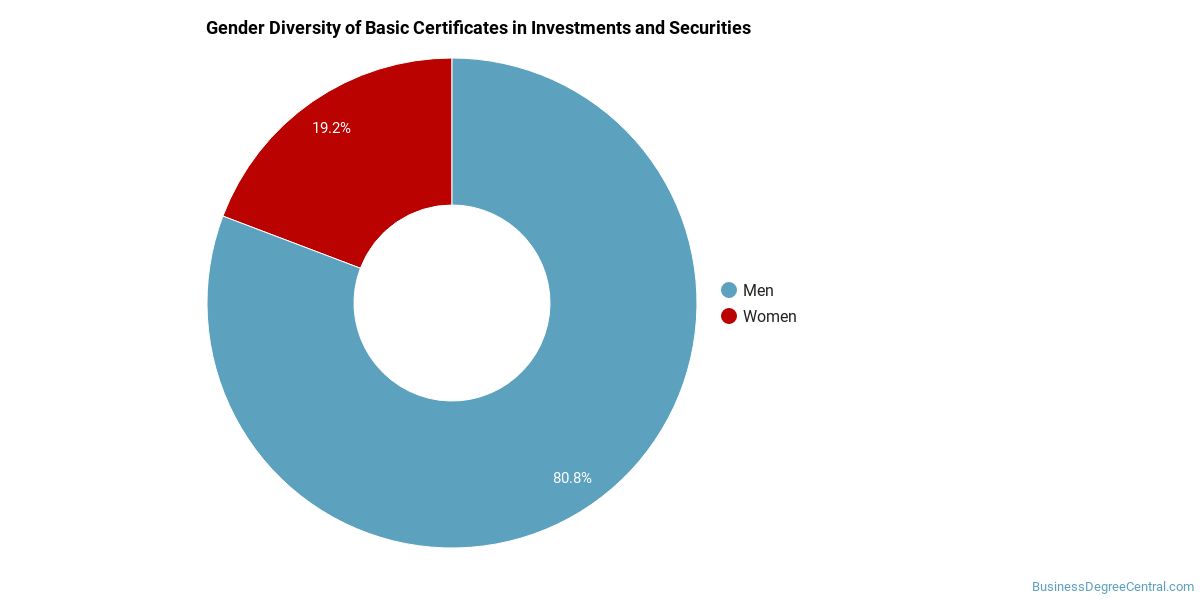
This degree is more popular with male students. About 86.6% of graduates in this field are men.
| Gender | Number of Grads |
|---|---|
| Men | 123 |
| Women | 19 |
The racial-ethnic distribution of Investments & Securities graduates is as follows:
| Race / Ethnicity | Number of Grads | Share |
|---|---|---|
| White | 107 | 75.4% |
| Asian | 4 | 2.8% |
| Hispanic or Latino | 14 | 9.9% |
| Black or African American | 4 | 2.8% |
| Two or More Races | 12 | 8.5% |
| International Students | 1 | 0.7% |
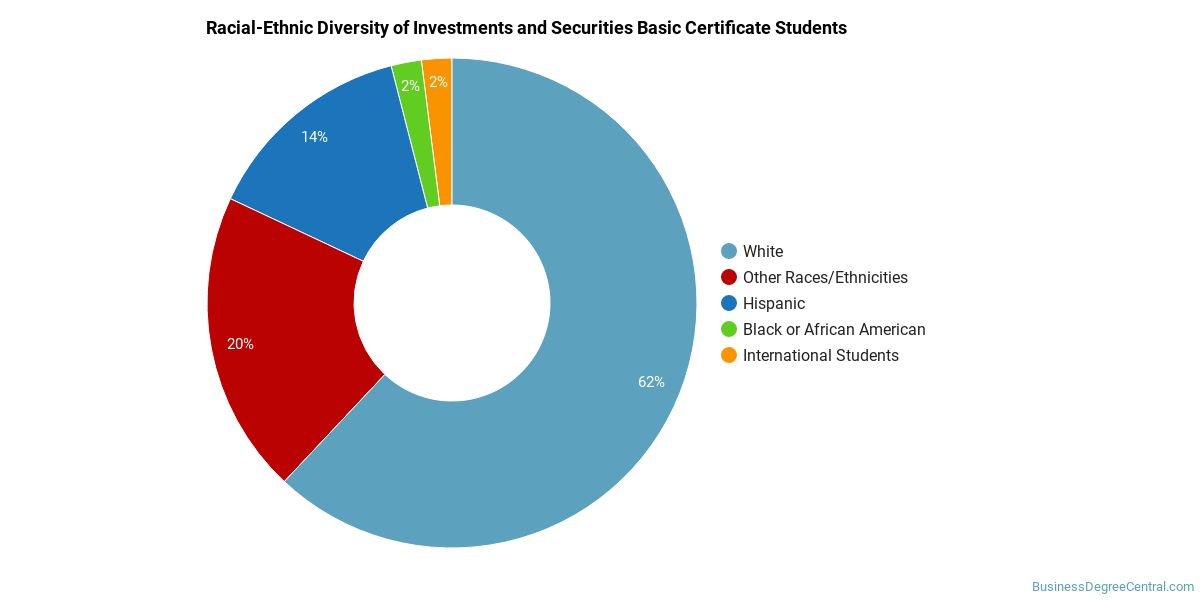
This degree is not very popular with international students. Only 0.7% of graduates fall into this category.
See the minority definition in the References below.
Most Popular Investments & Securities Programs for Basic Certificates
There are 32 colleges that offer a basic certificate in Investments & Securities. Learn more about the most popular below:

University of Missouri-Columbia tops the list of the most popular schools in the U.S. for Investments & Securities majors seeking their basic certificate. During the most recent year for which we have data, 87 people received their basic certificate in Investments & Securities from this school. Graduates who complete their basic certificate in Investments & Securities here go on to a median salary of $40,669.
Merrimack College is a popular choice for Investments & Securities majors seeking their basic certificate. This school awarded 63 basic certificates in Investments & Securities in the most recent reporting year. Data shows that graduates who hold this degree go on to make a median salary of $40,669.
Harvard University comes in at #3 on our list of the most popular colleges offering basic certificates in Investments & Securities. During the most recent year for which we have data, 51 people received their basic certificate in Investments & Securities from this school. Graduates who complete their basic certificate in Investments & Securities here go on to a median salary of $40,669.
University of North Dakota is a popular choice for Investments & Securities majors seeking their basic certificate. This school awarded 51 basic certificates in Investments & Securities in the most recent reporting year. Data shows that graduates who hold this degree go on to make a median salary of $40,669.
Northern Arizona University comes in at #5 on our list of the most popular colleges offering basic certificates in Investments & Securities. This school awarded 42 basic certificates in Investments & Securities in the most recent reporting year. Data shows that graduates who hold this degree go on to make a median salary of $40,669.
Lynn University comes in at #6 on our list of the most popular colleges offering basic certificates in Investments & Securities. This school awarded 19 basic certificates in Investments & Securities in the most recent reporting year. Graduates who complete their basic certificate in Investments & Securities here go on to a median salary of $40,669.
Fordham University is a popular choice for Investments & Securities majors seeking their basic certificate. This school awarded 17 basic certificates in Investments & Securities in the most recent reporting year. Graduates who complete their basic certificate in Investments & Securities here go on to a median salary of $40,669.
Creighton University comes in at #8 on our list of the most popular colleges offering basic certificates in Investments & Securities. During the most recent year for which we have data, 11 people received their basic certificate in Investments & Securities from this school. Data shows that graduates who hold this degree go on to make a median salary of $40,669.
Johns Hopkins University is a popular choice for Investments & Securities majors seeking their basic certificate. During the most recent year for which we have data, 10 people received their basic certificate in Investments & Securities from this school. Data shows that graduates who hold this degree go on to make a median salary of $40,669.
University of Arkansas-Fort Smith comes in at #10 on our list of the most popular colleges offering basic certificates in Investments & Securities. During the most recent year for which we have data, 9 people received their basic certificate in Investments & Securities from this school. Data shows that graduates who hold this degree go on to make a median salary of $40,669.
University of Northern Iowa comes in at #11 on our list of the most popular colleges offering basic certificates in Investments & Securities. During the most recent year for which we have data, 8 people received their basic certificate in Investments & Securities from this school. Data shows that graduates who hold this degree go on to make a median salary of $40,669.
George Washington University is a popular choice for Investments & Securities majors seeking their basic certificate. This school awarded 7 basic certificates in Investments & Securities in the most recent reporting year. Data shows that graduates who hold this degree go on to make a median salary of $40,669.
Pace University comes in at #13 on our list of the most popular colleges offering basic certificates in Investments & Securities. During the most recent year for which we have data, 7 people received their basic certificate in Investments & Securities from this school. Graduates who complete their basic certificate in Investments & Securities here go on to a median salary of $40,669.
Saint Joseph's University - Philadelphia comes in at #14 on our list of the most popular colleges offering basic certificates in Investments & Securities. During the most recent year for which we have data, 7 people received their basic certificate in Investments & Securities from this school. Graduates who complete their basic certificate in Investments & Securities here go on to a median salary of $40,669.
Saint Vincent College is a popular choice for Investments & Securities majors seeking their basic certificate. During the most recent year for which we have data, 6 people received their basic certificate in Investments & Securities from this school. Graduates who complete their basic certificate in Investments & Securities here go on to a median salary of $40,669.
Nichols College is a popular choice for Investments & Securities majors seeking their basic certificate. During the most recent year for which we have data, 4 people received their basic certificate in Investments & Securities from this school. Graduates who complete their basic certificate in Investments & Securities here go on to a median salary of $40,669.
University of Nebraska at Omaha comes in at #17 on our list of the most popular colleges offering basic certificates in Investments & Securities. This school awarded 4 basic certificates in Investments & Securities in the most recent reporting year. Data shows that graduates who hold this degree go on to make a median salary of $40,669.
Colorado State University-Fort Collins is a popular choice for Investments & Securities majors seeking their basic certificate. This school awarded 3 basic certificates in Investments & Securities in the most recent reporting year. Data shows that graduates who hold this degree go on to make a median salary of $40,669.
Ocean County College is a popular choice for Investments & Securities majors seeking their basic certificate. This school awarded 2 basic certificates in Investments & Securities in the most recent reporting year. Graduates who complete their basic certificate in Investments & Securities here go on to a median salary of $40,669.
Texas A&M University-College Station is a popular choice for Investments & Securities majors seeking their basic certificate. During the most recent year for which we have data, 2 people received their basic certificate in Investments & Securities from this school. Graduates who complete their basic certificate in Investments & Securities here go on to a median salary of $40,669.
Explore Investments & Securities by State
Alabama
California
District of Columbia
Idaho
Kansas
Maryland
Mississippi
Nevada
New York
Oklahoma
South Carolina
Utah
West Virginia
Alaska
Colorado
Florida
Illinois
Kentucky
Massachusetts
Missouri
New Hampshire
North Carolina
Oregon
South Dakota
Vermont
Wisconsin
Related Majors
Below are some popular majors similar to Investments & Securities that also offer basic certificates.
| Major | Annual Degrees Awarded |
|---|---|
| Finance, General | 49,828 |
| Financial Planning and Services | 5,773 |
| Banking and Financial Support Services | 992 |
| Finance and Financial Management Services, Other | 363 |
| International Finance | 124 |
References
The racial-ethnic minority student count is calculated by taking the total number of students and subtracting white students, international students, and students whose race/ethnicity was unknown. This number is then divided by the total number of students to obtain the percentage of racial-ethnic minorities.
- College Factual
- National Center for Education Statistics (IPEDS)
- O*NET Online
- U.S. Bureau of Labor Statistics
- U.S. Department of Education College Scorecard
More about our data sources and methodologies.

BusinessDegreeCentral.com provides higher-education, college and university, degree, program, career, salary, and other helpful information to students, faculty, institutions, and other internet audiences. Presented information and data are subject to change. Inclusion on this website does not imply or represent a direct relationship with the company, school, or brand. Information, though believed correct at time of publication, may not be correct, and no warranty is provided. Contact the schools to verify any information before relying on it. Financial aid may be available for those who qualify. The displayed options may include sponsored or recommended results, not necessarily based on your preferences.
© BusinessDegreeCentral.com – All Rights Reserved.