William Penn University Business Programs
William Penn University is a private not-for-profit institution located in Oskaloosa, IA. A Remote Town provides a peaceful environment near the excitement of urban amenities.
Featured schools near , edit
William Penn University Rankings
William Penn University is featured in these rankings for business programs at the bachelors level:
| Ranking | Rank | Among |
|---|---|---|
| Overall Quality | #44 of 69 | State — Iowa |
| Overall Quality | #239 of 404 | Region — The Plains States |
| Overall Quality | #1901 of 4,630 | Nationwide |
Where Is William Penn University?
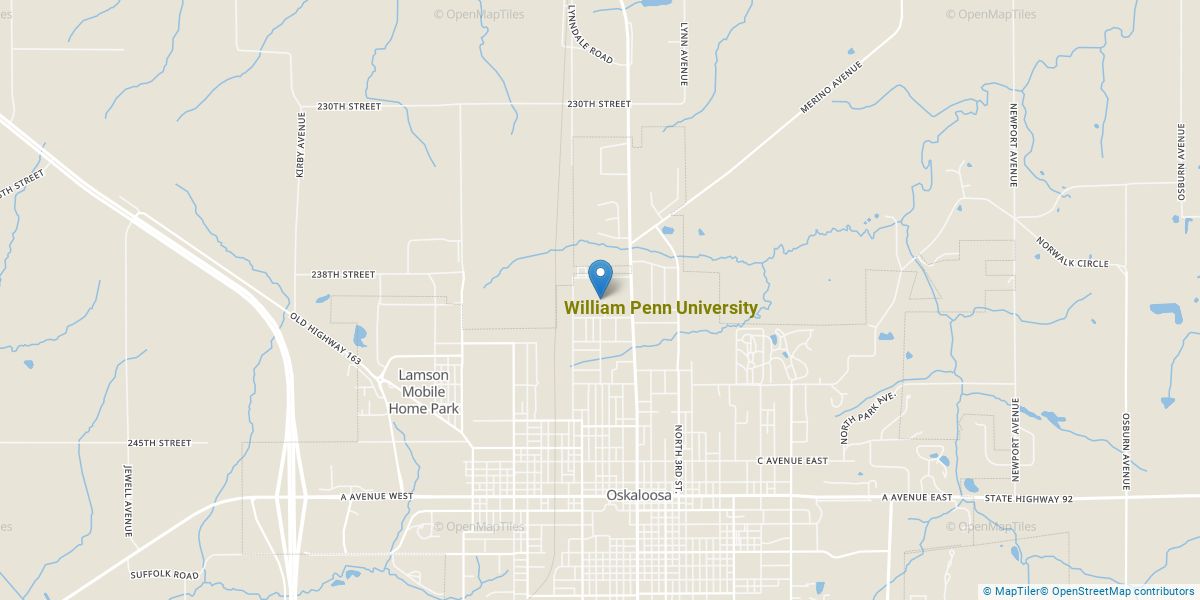
Get in touch with William Penn University can be found below.
| Contact Details | |
|---|---|
| Address: | 201 Trueblood Ave, Oskaloosa, IA 52577 |
| Phone: | 6416731001 |
| Website: | www.wmpenn.edu/ |
| Admissions: | www.wmpenn.edu/admissions-aid/admissions/ |
| Financial Aid: | www.wmpenn.edu/financial-aid/ |
How Do I Get Into William Penn University?
You can apply to William Penn University online at: https://application.wmpenn.edu/
William Penn University is classified as Moderately Selective (50-70%) for admissions.
Admission Requirements for William Penn University
Here’s what William Penn University looks for in applicants:
| Requirement | Status |
|---|---|
| Secondary School Record | Required |
| Secondary School GPA | Required |
| Recommendations | Considered but not required |
| Admission Test Scores (SAT/ACT) | Considered but not required |
How Hard Is It To Get Into William Penn University?
William Penn University has an acceptance rate of 52%, which makes it fairly accessible. Be sure to prepare a complete application and prepare the application in full.
Of those admitted, 42% choose to enroll — a strong indicator that admitted students commit to enrolling.
Average Test Scores
21% of admitted students submitted SAT scores and 32% submitted ACT scores.
When looking at the 25th through the 75th percentile of admitted students at William Penn University, SAT Evidence-Based Reading and Writing scores ranged between 450 and 570. Math scores were between 430 and 540.
Selectivity by Gender
Acceptance rates at William Penn University are broken out by gender below.
| Gender | Applicants | Admitted | Acceptance Rate |
|---|---|---|---|
| Men | 975 | 472 | 48% |
| Women | 330 | 205 | 62% |
Can I Afford William Penn University?
The average net price after aid at William Penn University is $22,115. Cost varies significantly based on your financial situation since net price varies by income group.
Tuition & Fees
| Category | Cost |
|---|---|
| In-State Tuition | $29,750 |
| In-State Fees | $N/A |
| Out-of-State Tuition | $29,750 |
| Out-of-State Fees | $N/A |
| Total In-State Tuition & Fees | $29,750 |
| Total Out-of-State Tuition & Fees | $29,750 |
Financial Aid
Across all aid types, 20% of students at William Penn University receive some form of financial aid (294 students).
About 96% of students at William Penn University receive grant or scholarship aid, averaging $19,776 per student.
47% of students receive federal Pell Grants, averaging $5,400.
Student Loan Debt
88% of William Penn University undergraduates take out federal student loans, averaging $6,919 per year.
William Penn University Undergraduate Student Diversity
There are 81 students enrolled at William Penn University. William Penn University is classified as a 1,000 - 4,999 institution by enrollment size. Its Carnegie Classification is Baccalaureate Colleges: Diverse Fields.
Gender Diversity
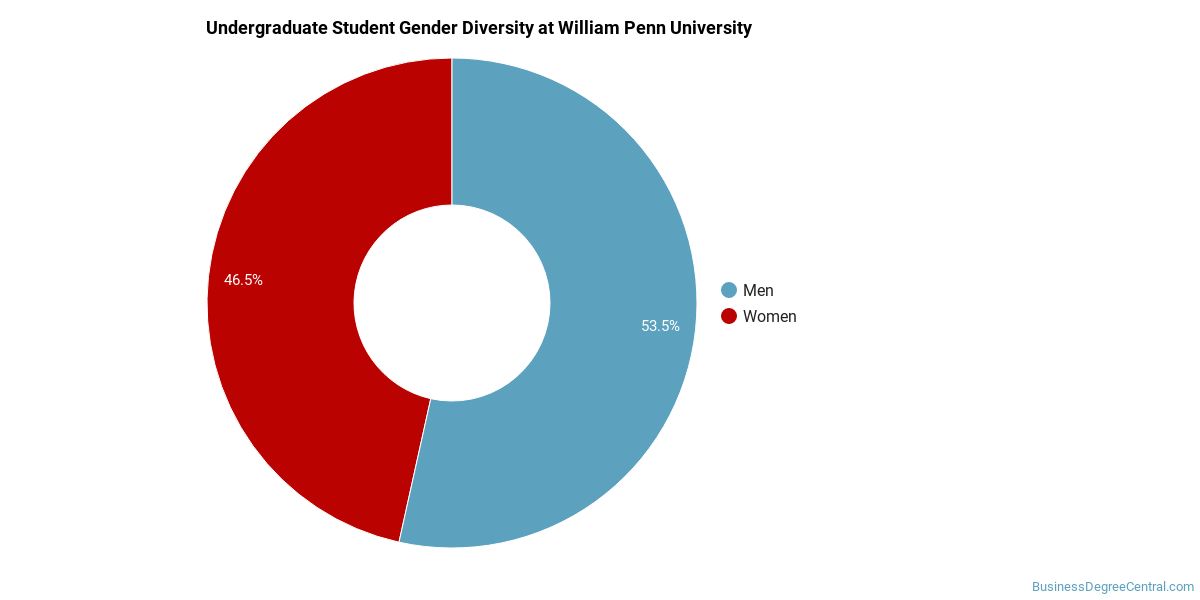
Of the 1,391 undergraduate students at William Penn University, approximately 53% are male and 47% are female.
Racial-Ethnic Diversity
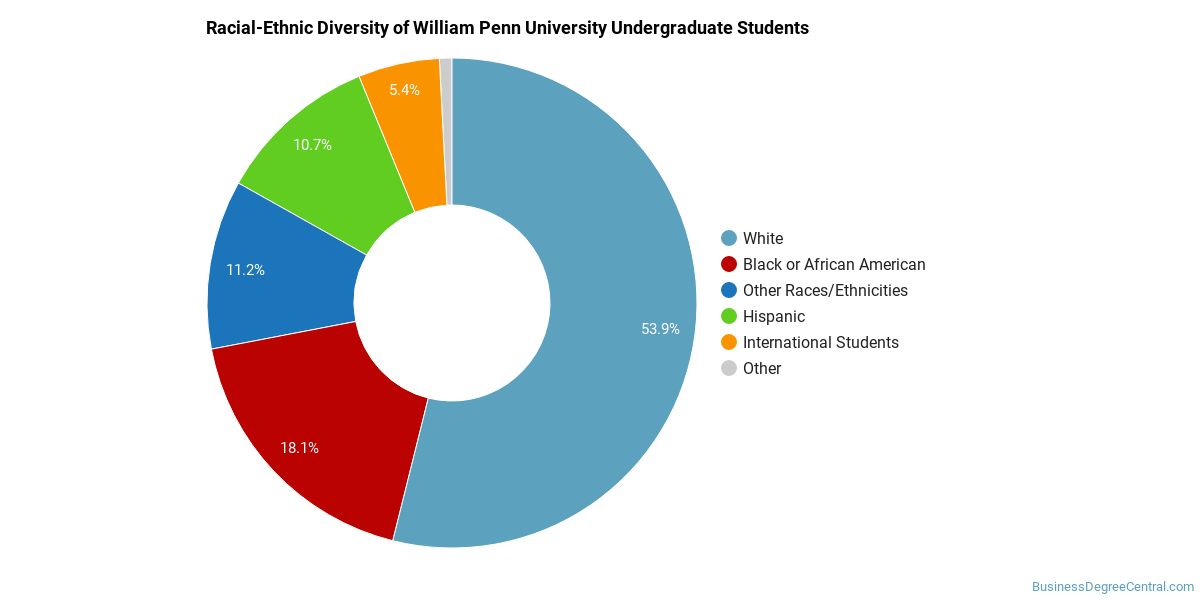
The racial-ethnic breakdown of William Penn University undergraduate students is as follows.
| Race/Ethnicity | Number of Students |
|---|---|
| Asian | 2 |
| Black or African American | 244 |
| Hispanic | 126 |
| White | 797 |
| American Indian/Alaska Native | 12 |
| Native Hawaiian/Pacific Islander | 8 |
| Two or More Races | 84 |
| Non-Resident | 84 |
Geographic Diversity
The top 5 home states of first-time undergraduate students at William Penn University are listed below.

| State | First-Time UG Students |
|---|---|
| Iowa | 94 |
| Texas | 40 |
| Florida | 21 |
| Illinois | 19 |
| Wisconsin | 9 |
Additionally, approximately 6.1% of undergraduate students are non-resident from outside the United States.
William Penn University Graduate Student Diversity
87 of William Penn University’s students are in graduate programs. The highest graduate-level award offered is Master’s degree.
Gender Diversity (Graduate)
Among graduate students at William Penn University, approximately 61% are male and 39% are female.

Racial-Ethnic Diversity (Graduate)
The racial-ethnic breakdown of William Penn University graduate students is as follows.

| Race/Ethnicity | Number of Students |
|---|---|
| Black or African American | 4 |
| Hispanic | 10 |
| White | 46 |
| Two or More Races | 3 |
| Non-Resident | 22 |
Online Learning at William Penn University
William Penn University provides distance learning options for students who need flexibility.
252 undergraduate students at William Penn University took at least one online class — of those, 207 took all of their classes online.
At the graduate level, 0 students took at least one online class and 19 took all classes online. Distance education is available at the undergraduate and graduate levels.
Business Programs at William Penn University
Below are the business degree programs are offered by William Penn University, showing degrees awarded by level in the most recent reporting year.
| Program | Bachelor’s | Master’s | Doctorate | Total |
|---|---|---|---|---|
| Business Administration, Management and Operations | 49 | 19 | — | 68 |
| Accounting and Related Services | 4 | — | — | 4 |
| Entrepreneurial and Small Business Operations | 4 | — | — | 4 |
| Human Resources Management and Services | 3 | — | — | 3 |
Academic Programs at William Penn University
William Penn University offers 17 distinct academic programs.
The highest level of award offered is Master’s degree.
Institutional Profile
William Penn University has an open admission policy: No. Credit transfer:
- AP credits: Implied no
- Dual enrollment credits: Yes
- Life experience credits: Implied no
References
More about our data sources and methodologies.
Featured Schools

You have goals. Southern New Hampshire University can help you get there. Whether you need a bachelor's degree to get into a career or want a master's degree to move up in your current career, SNHU has an online program for you. Find your degree from over 200 online programs.
Visit School
BusinessDegreeCentral.com provides higher-education, college and university, degree, program, career, salary, and other helpful information to students, faculty, institutions, and other internet audiences. Presented information and data are subject to change. Inclusion on this website does not imply or represent a direct relationship with the company, school, or brand. Information, though believed correct at time of publication, may not be correct, and no warranty is provided. Contact the schools to verify any information before relying on it. Financial aid may be available for those who qualify. The displayed options may include sponsored or recommended results, not necessarily based on your preferences.
© BusinessDegreeCentral.com – All Rights Reserved.