What is an Environmental Economist?
Career Description Conduct economic analysis related to environmental protection and use of the natural environment, such as water, air, land, and renewable energy resources. Evaluate and quantify benefits, costs, incentives, and impacts of alternative options using economic principles and statistical techniques.
Life As an Environmental Economist
- Develop economic models, forecasts, or scenarios to predict future economic and environmental outcomes.
- Write technical documents or academic articles to communicate study results or economic forecasts.
- Demonstrate or promote the economic benefits of sound environmental regulations.
- Monitor or analyze market and environmental trends.
- Perform complex, dynamic, and integrated mathematical modeling of ecological, environmental, or economic systems.
- Write research proposals and grant applications to obtain private or public funding for environmental and economic studies.
Featured schools near , edit
Environmental Economist Required Skills
Below is a list of the skills most Environmental Economists say are important on the job.
Reading Comprehension: Understanding written sentences and paragraphs in work related documents.
Writing: Communicating effectively in writing as appropriate for the needs of the audience.
Critical Thinking: Using logic and reasoning to identify the strengths and weaknesses of alternative solutions, conclusions or approaches to problems.
Active Listening: Giving full attention to what other people are saying, taking time to understand the points being made, asking questions as appropriate, and not interrupting at inappropriate times.
Judgment and Decision Making: Considering the relative costs and benefits of potential actions to choose the most appropriate one.
Mathematics: Using mathematics to solve problems.
Related Job Titles for this Occupation:
- Energy Economist
- Natural Resource Economist
- Environmental Protection Economist
- Senior Economist
- Agricultural Economist
Are There Job Opportunities for Environmental Economists?
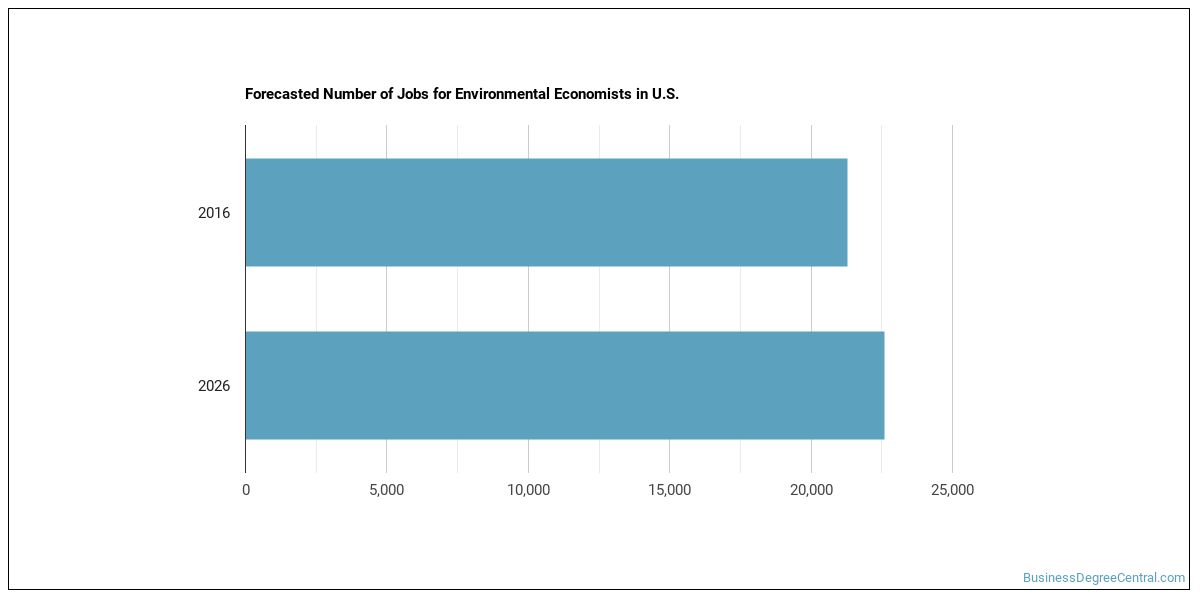
In 2016, there was an estimated number of 21,300 jobs in the United States for Environmental Economist. New jobs are being produced at a rate of 6.1% which is above the national average. The Bureau of Labor Statistics predicts 1,300 new jobs for Environmental Economist by 2026. There will be an estimated 1,600 positions for Environmental Economist per year.
The states with the most job growth for Environmental Economist are Alabama, Louisiana, and Washington. Watch out if you plan on working in Wyoming, West Virginia, or Vermont. These states have the worst job growth for this type of profession.
Environmental Economist Salary
The salary for Environmental Economists ranges between about $58,130 and $182,560 a year.
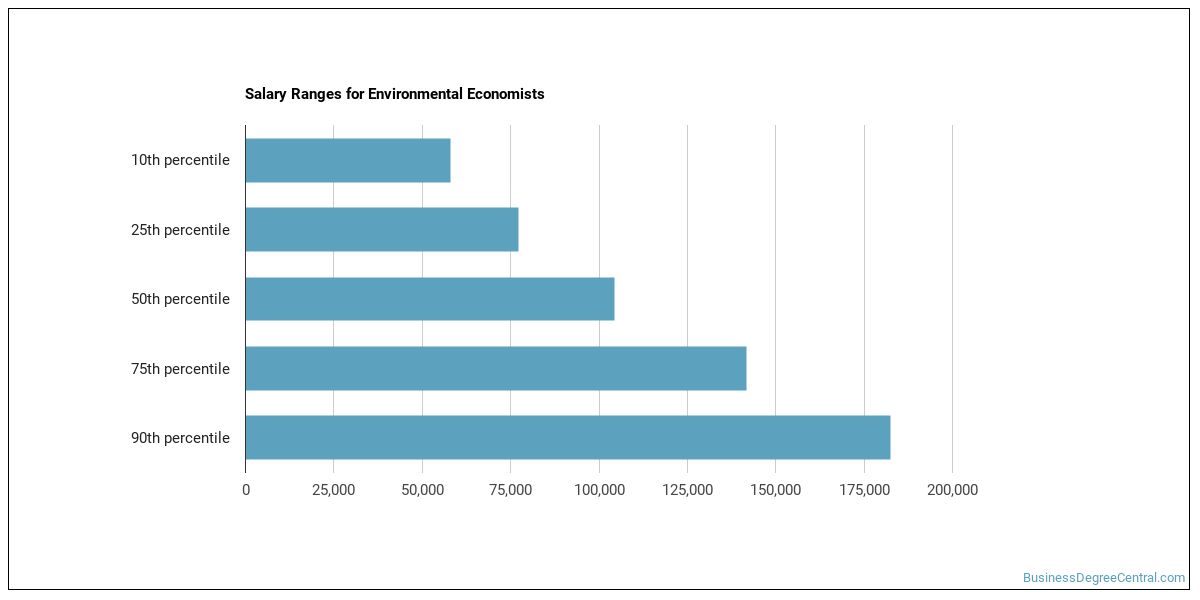
Environmental Economists who work in District of Columbia, Virginia, or Maryland, make the highest salaries.
How much do Environmental Economists make in different U.S. states?
| State | Annual Mean Salary |
|---|---|
| Alabama | $103,740 |
| Alaska | $85,970 |
| Arizona | $93,350 |
| Arkansas | $75,380 |
| California | $124,430 |
| Colorado | $104,350 |
| Connecticut | $95,450 |
| Delaware | $86,850 |
| District of Columbia | $134,260 |
| Florida | $105,230 |
| Georgia | $111,570 |
| Hawaii | $98,100 |
| Idaho | $61,130 |
| Illinois | $108,690 |
| Indiana | $84,740 |
| Iowa | $87,530 |
| Kansas | $72,600 |
| Louisiana | $103,070 |
| Maryland | $116,870 |
| Massachusetts | $117,680 |
| Michigan | $90,040 |
| Minnesota | $81,720 |
| Mississippi | $75,450 |
| Missouri | $112,240 |
| Montana | $89,980 |
| Nebraska | $81,010 |
| Nevada | $79,170 |
| New Hampshire | $74,570 |
| New Jersey | $100,500 |
| New Mexico | $87,680 |
| New York | $127,520 |
| North Carolina | $81,470 |
| Ohio | $125,490 |
| Oklahoma | $76,500 |
| Oregon | $87,420 |
| Pennsylvania | $87,630 |
| South Carolina | $68,550 |
| Tennessee | $83,350 |
| Texas | $106,480 |
| Utah | $88,280 |
| Vermont | $96,620 |
| Virginia | $126,080 |
| Washington | $95,010 |
| West Virginia | $68,430 |
| Wisconsin | $80,070 |
What Tools do Environmental Economists Use?
Below is a list of the types of tools and technologies that Environmental Economists may use on a daily basis:
- Microsoft Excel
- Microsoft Word
- Microsoft Office
- Microsoft PowerPoint
- Microsoft Outlook
- Web browser software
- Microsoft Access
- MySQL
- The MathWorks MATLAB
- SAS
- Microsoft Visual Basic
- IBM SPSS Statistics
- Minitab
- C
- StataCorp Stata
- Wolfram Research Mathematica
- Formula translation/translator FORTRAN
- Insightful S-PLUS
- ESRI ArcGIS software
- Aptech Systems GAUSS
How do I Become an Environmental Economist?
Learn what Environmental Economist education requirements there are.

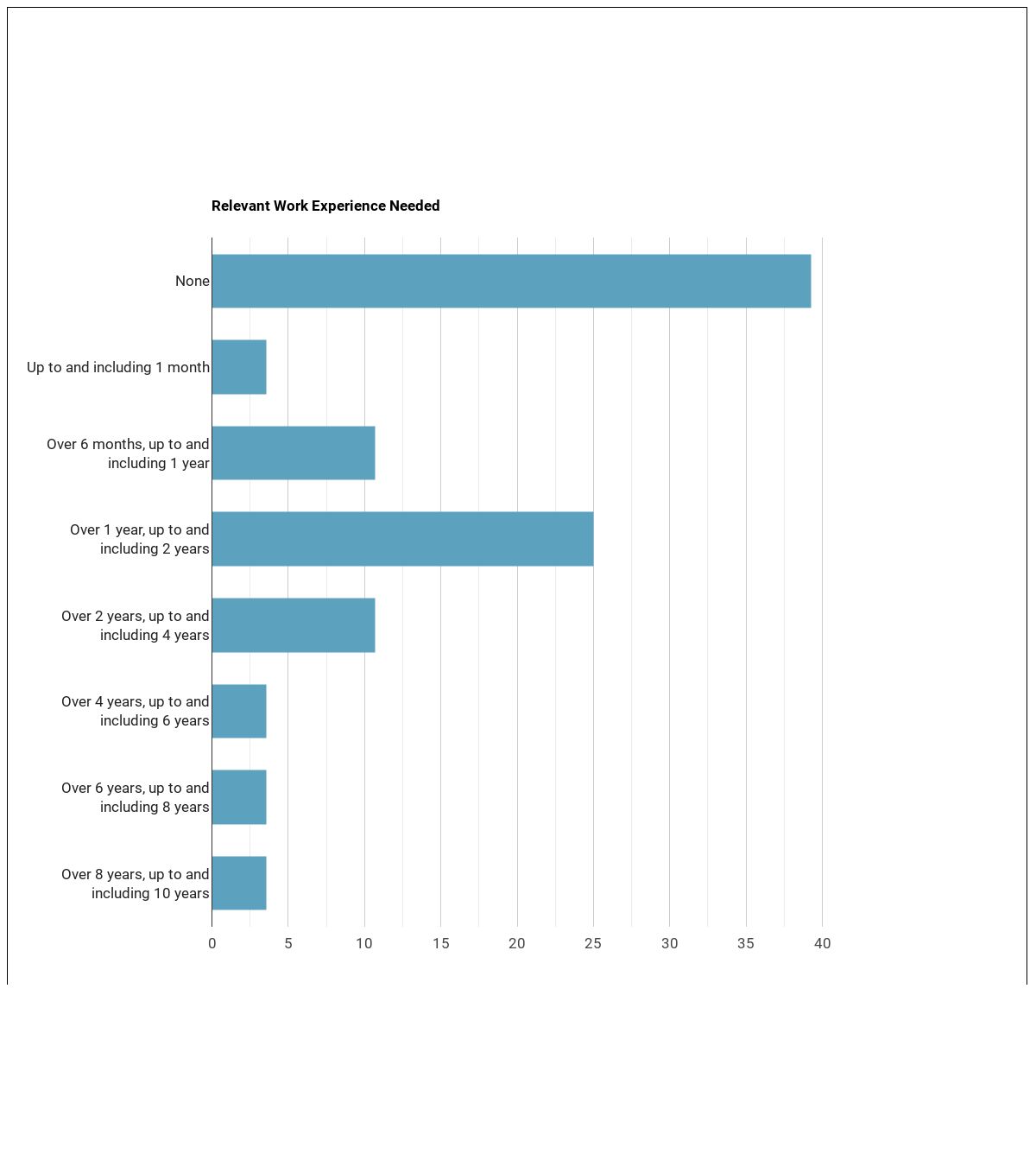
How many years of work experience do I need?
Where Environmental Economists Work
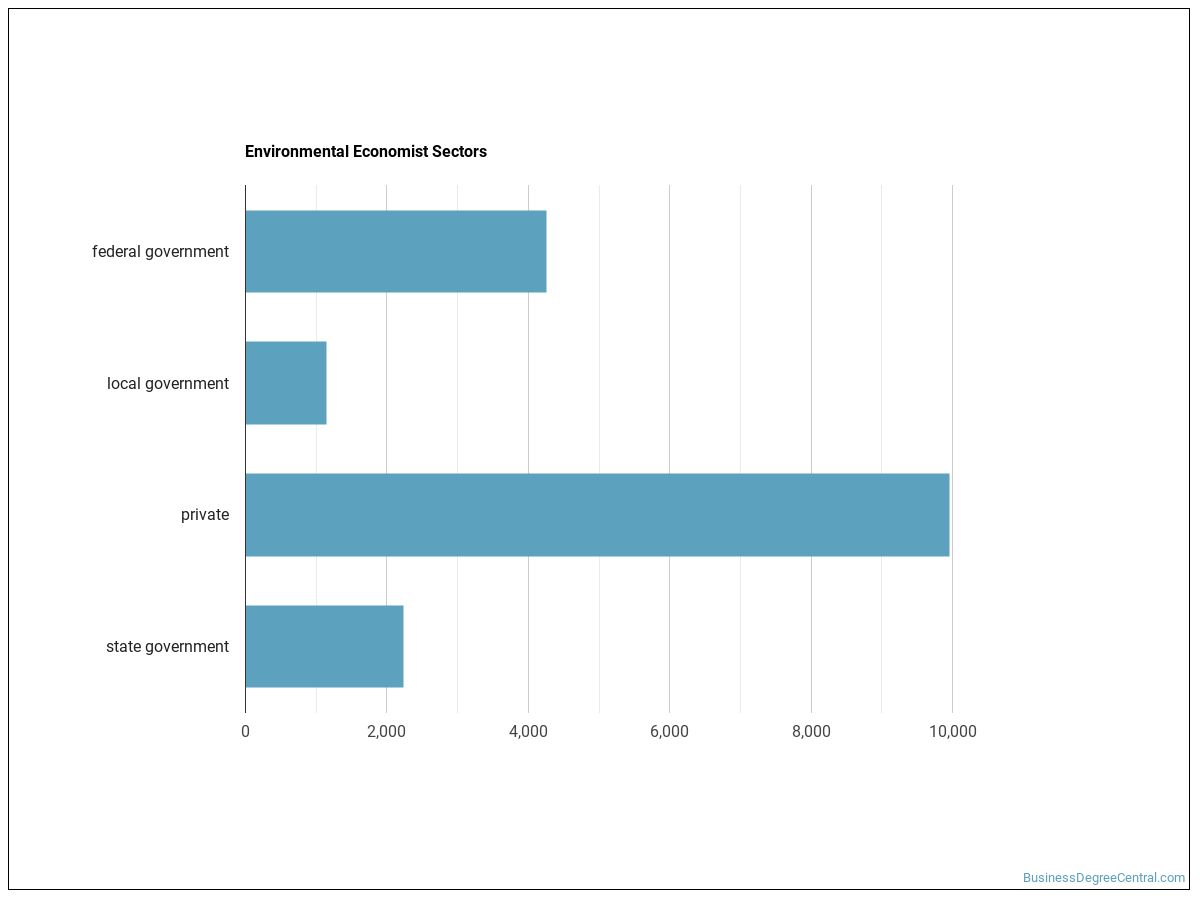
The table below shows some of the most common industries where those employed in this career field work.

References:
Image Credit: Bernard Ladenthin via Public domain
More about our data sources and methodologies.
Featured Schools

You have goals. Southern New Hampshire University can help you get there. Whether you need a bachelor's degree to get into a career or want a master's degree to move up in your current career, SNHU has an online program for you. Find your degree from over 200 online programs.
Visit School
BusinessDegreeCentral.com provides higher-education, college and university, degree, program, career, salary, and other helpful information to students, faculty, institutions, and other internet audiences. Presented information and data are subject to change. Inclusion on this website does not imply or represent a direct relationship with the company, school, or brand. Information, though believed correct at time of publication, may not be correct, and no warranty is provided. Contact the schools to verify any information before relying on it. Financial aid may be available for those who qualify. The displayed options may include sponsored or recommended results, not necessarily based on your preferences.
© BusinessDegreeCentral.com – All Rights Reserved.