Credit Analysts: Career Overview
Analyze credit data and financial statements of individuals or firms to determine the degree of risk involved in extending credit or lending money. Prepare reports with credit information for use in decisionmaking.
Featured schools near , edit
What Do Credit Analysts Take On?
Typical responsibilities of credit analysts cover:
- Analyze credit data and financial statements to determine the degree of risk involved in extending credit or lending money.
- Complete loan applications, including credit analyses and summaries of loan requests, and submit to loan committees for approval.
- Generate financial ratios, using computer programs, to evaluate customers' financial status.
- Prepare reports that include the degree of risk involved in extending credit or lending money.
- Analyze financial data, such as income growth, quality of management, and market share to determine expected profitability of loans.
- Compare liquidity, profitability, and credit histories of establishments being evaluated with those of similar establishments in the same industries and geographic locations.
- Consult with customers to resolve complaints and verify financial and credit transactions.
Skills and Knowledge
Top credit analysts rely on a mix of skills and domain knowledge.
Most Important Skills
The abilities most important for this role, rated on an importance scale of 0 to 5:
Top Knowledge Areas
Types of Credit Analysts Jobs
People in this occupation may also be known by titles such as:
- Commercial Credit Analyst
- Commercial Credit Manager
- Credit Administrator
- Credit Analyst
- Credit Assessment Analyst
- Credit Assistant Manager
- Credit Coordinator
- Credit Manager
Job Outlook
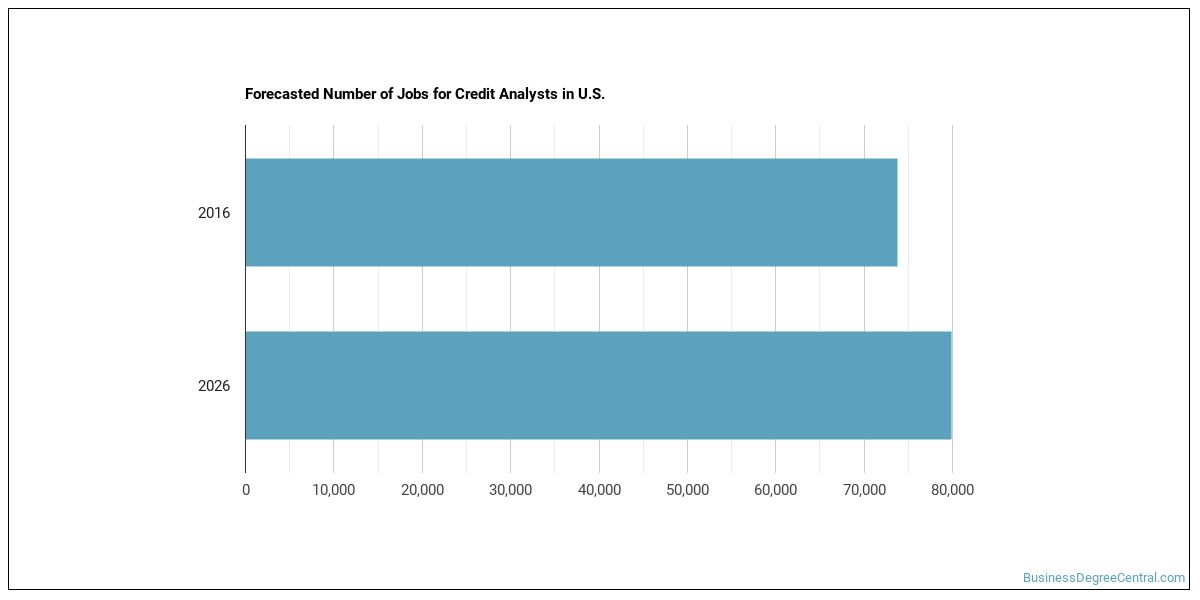
The U.S. employs around 285,612 credit analysts working in the United States today. Employment is projected to decline by -3.7% over the projection horizon.
How Much Do Credit Analysts Make?
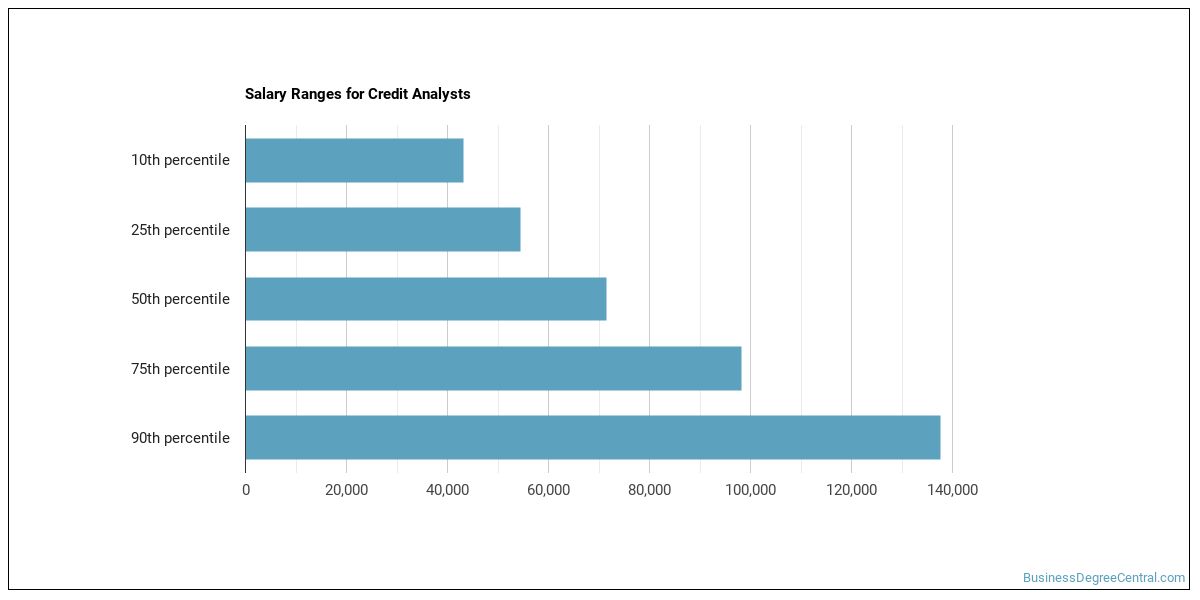
| Statistic | Value |
|---|---|
| Annual median | $66,233 |
| Hourly median | $31.84 |
| 10th percentile | $37,343 |
| 25th percentile | $51,788 |
| 75th percentile | $80,678 |
| 90th percentile | $95,123 |
Pay can vary substantially based on experience, location, and industry.
Credit Analysts Salary by State
| State | Annual median salary |
|---|---|
| New York | $132,690 |
| District of Columbia | $103,530 |
| Alabama | $101,050 |
| New Jersey | $100,210 |
| Delaware | $99,030 |
| Virginia | $97,590 |
| Colorado | $95,670 |
| Massachusetts | $88,490 |
| California | $88,360 |
| North Carolina | $88,230 |
| Connecticut | $86,560 |
| Washington | $85,650 |
| Rhode Island | $83,520 |
| North Dakota | $82,210 |
| Vermont | $82,090 |
| Illinois | $81,380 |
| Nebraska | $81,160 |
| Maryland | $80,940 |
| New Hampshire | $80,750 |
| Pennsylvania | $80,650 |
| Maine | $79,690 |
| Minnesota | $79,280 |
| Oregon | $78,650 |
| Texas | $77,300 |
| New Mexico | $76,950 |
| Hawaii | $76,800 |
| Iowa | $76,460 |
| Florida | $76,240 |
| South Carolina | $76,050 |
| Louisiana | $75,820 |
| Kentucky | $75,320 |
| Arizona | $74,580 |
| Georgia | $73,300 |
| Michigan | $72,620 |
| Utah | $72,500 |
| Mississippi | $72,090 |
| Wyoming | $71,920 |
| Wisconsin | $70,640 |
| Kansas | $70,040 |
| South Dakota | $68,320 |
| Ohio | $67,970 |
| Tennessee | $66,980 |
| Montana | $65,690 |
| Idaho | $65,520 |
| Arkansas | $64,910 |
| Oklahoma | $64,830 |
| Nevada | $64,500 |
| Indiana | $64,230 |
| Missouri | $63,440 |
| Alaska | $61,930 |
| West Virginia | $55,840 |
| Puerto Rico | $47,160 |
Pay by U.S. Region
Pay for credit analysts shift depending on where you work. The following regions pay the most:
| Region | Median annual wage | Share of U.S. jobs | Location quotient |
|---|---|---|---|
| Middle Atlantic | $114,778 | 19.8% | 1.57 |
| New England | $86,409 | 4.4% | 0.97 |
| Far Western US | $85,953 | 13.2% | 0.80 |
| Southeast | $80,044 | 22.1% | 1.01 |
| Rocky Mountains | $79,893 | 3.6% | 0.94 |
| Southwest | $75,720 | 14.5% | 1.24 |
| Plains States | $73,566 | 7.0% | 1.10 |
| Great Lakes | $72,830 | 14.3% | 1.10 |
Top Metro Areas
| Metro area | State | Median annual wage | Employment |
|---|---|---|---|
| New York-Newark-Jersey City, NY-NJ | NY | $133,180 | 7,820 |
| San Francisco-Oakland-Fremont, CA | CA | $127,470 | 1,090 |
| Winston-Salem, NC | NC | $124,520 | 100 |
| Birmingham, AL | AL | $105,510 | 190 |
| Washington-Arlington-Alexandria, DC-VA-MD-WV | DC | $105,010 | 1,060 |
| Bridgeport-Stamford-Danbury, CT | CT | $101,880 | 180 |
| Denver-Aurora-Centennial, CO | CO | $100,670 | 700 |
| Richmond, VA | VA | $100,460 | 550 |
Top Industries Employing Credit Analysts
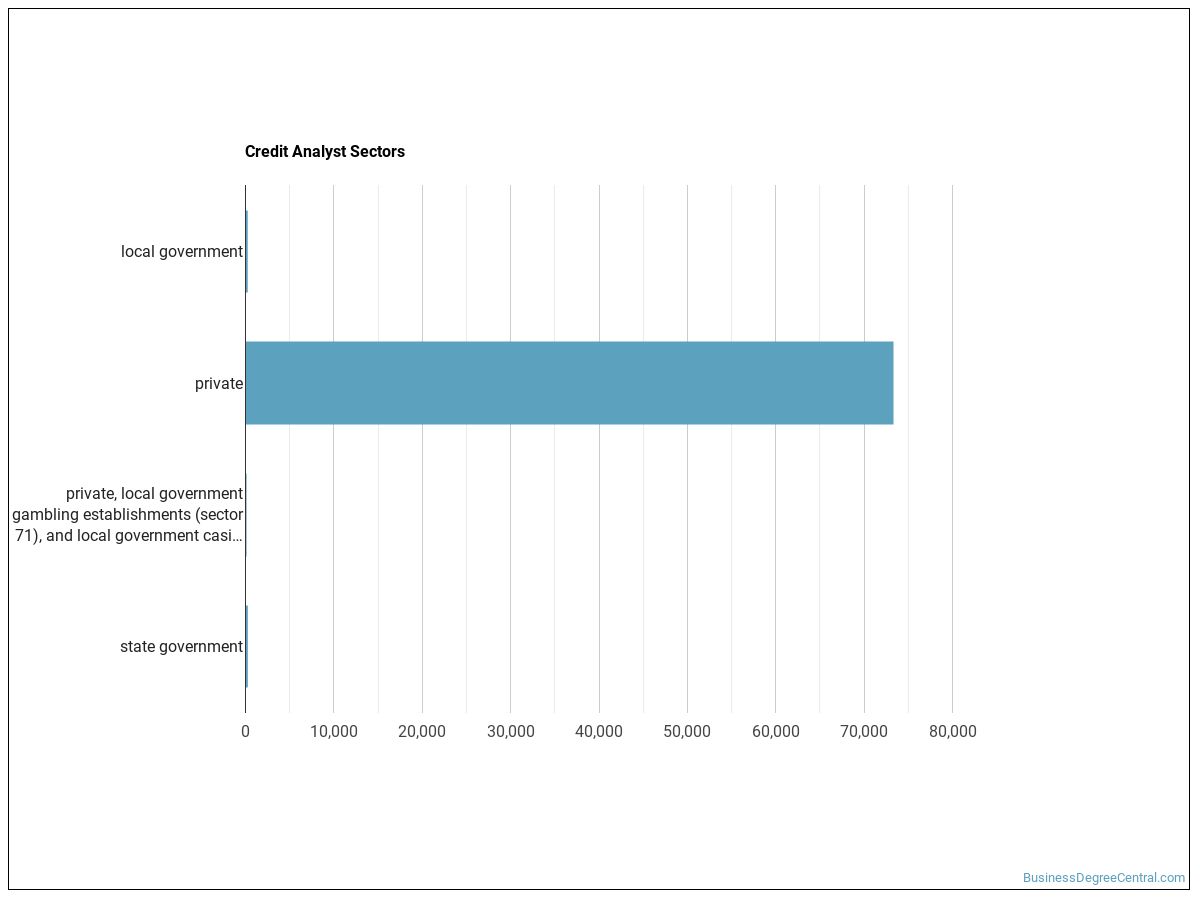
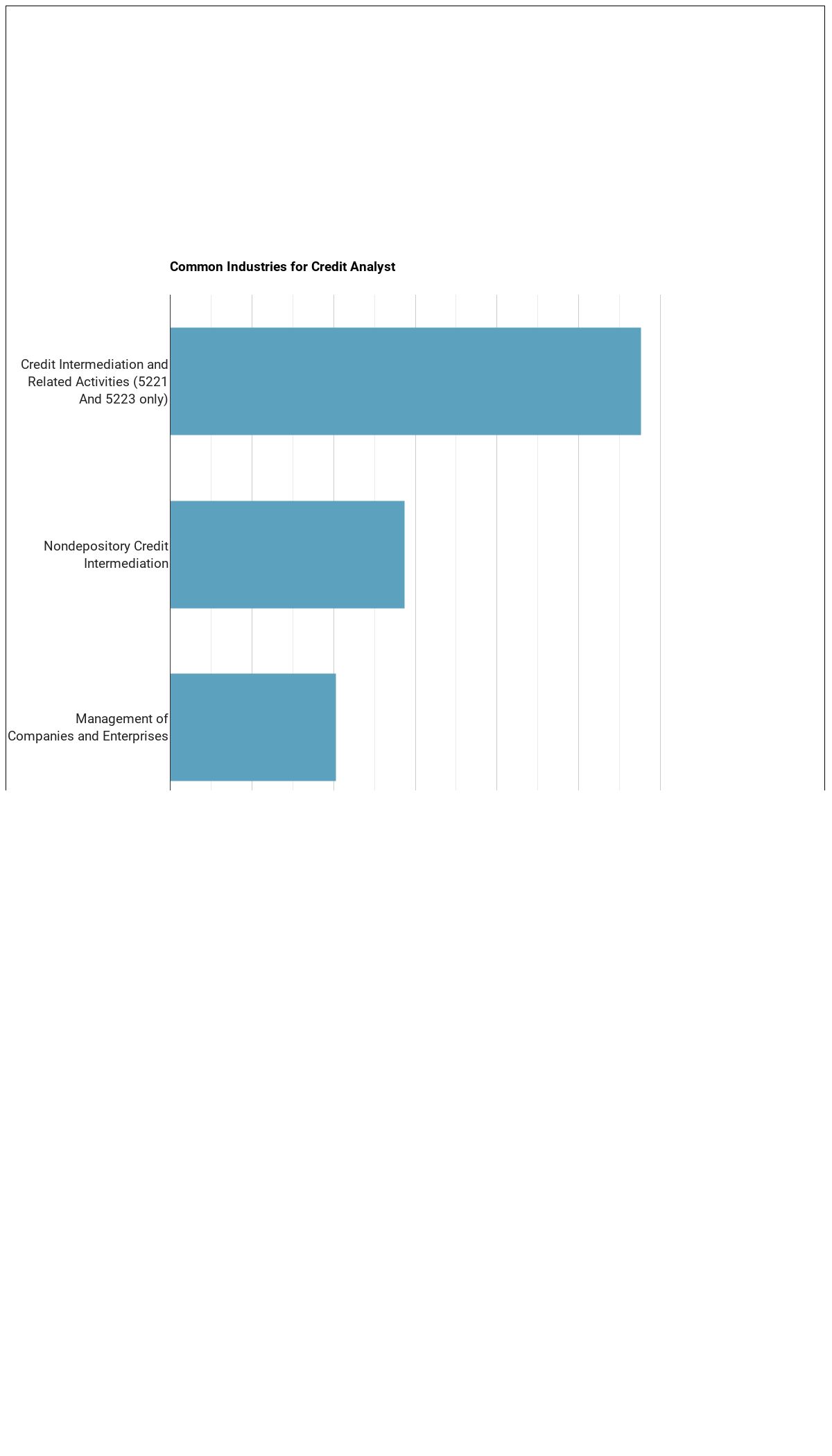
Most credit analysts work in these industries:
| Industry | Employment | Median annual wage |
|---|---|---|
| Finance and Insurance | 48,610 | $82,170 |
| Management of Companies and Enterprises | 7,720 | $81,730 |
| Wholesale Trade | 2,630 | $67,490 |
| Administrative and Support and Waste Management and Remediation Services | 2,000 | $87,940 |
| Retail Trade | 1,330 | $74,790 |
| Professional, Scientific, and Technical Services | 1,290 | $70,330 |
| Manufacturing | 1,200 | $67,980 |
| Information | 1,140 | $64,180 |
Credit Analysts work in the following industries:
Software Credit Analysts Use
- Spreadsheet software: Microsoft Excel (hot technology)
- Office suite software: Microsoft Office software (hot technology)
- Electronic mail software: Microsoft Outlook (hot technology)
- Presentation software: Microsoft PowerPoint (hot technology)
- Data base user interface and query software: Microsoft SQL Server (hot technology)
- Development environment software: Microsoft Visual Basic (hot technology)
- Development environment software: Microsoft Visual Basic for Applications VBA (hot technology)
- Word processing software: Microsoft Word (hot technology)
- Object or component oriented development software: Python (hot technology)
- Enterprise resource planning ERP software: SAP software (hot technology)
- Analytical or scientific software: SAS (hot technology)
- Data base user interface and query software: Structured query language SQL (hot technology)
Work Environment
The work environment for credit analysts reflects the following characteristics:
- Indoors, Environmentally Controlled
- Spend Time Sitting
- Telephone Conversations
- Face-to-Face Discussions with Individuals and Within Teams
Getting Started in This Career
Entry-level credit analysts positions require a bachelor’s degree as the typical entry-level education. The role falls in Considerable Preparation Needed (Job Zone 4), reflecting the level of preparation typically expected.
Related Careers
Similar Occupations
- Financial Managers (Supplemental)
- Investment Fund Managers (Supplemental)
- Accountants and Auditors (Primary-Long)
- Budget Analysts (Supplemental)
- Financial and Investment Analysts (Primary-Short)
- Personal Financial Advisors (Primary-Long)
- Insurance Underwriters (Supplemental)
- Financial Risk Specialists (Primary-Long)
Degree Programs
Students preparing for credit analysts often complete programs in:
Business, Management, Marketing, and Related Support Services
4 programs across 2 majors
About the Data
Statistics shown above are sourced from the following authoritative sources:
- U.S. Bureau of Labor Statistics — Occupational Employment and Wage Statistics (OEWS) for employment and wage data by state and industry.
- BLS Employment Projections for total employment and growth forecasts.
- O*NET (Occupational Information Network) for skills, knowledge, tasks, work activities, work context, technology, and education-zone data.
SOC code: 13-2041.00 (Credit Analysts).

BusinessDegreeCentral.com provides higher-education, college and university, degree, program, career, salary, and other helpful information to students, faculty, institutions, and other internet audiences. Presented information and data are subject to change. Inclusion on this website does not imply or represent a direct relationship with the company, school, or brand. Information, though believed correct at time of publication, may not be correct, and no warranty is provided. Contact the schools to verify any information before relying on it. Financial aid may be available for those who qualify. The displayed options may include sponsored or recommended results, not necessarily based on your preferences.
© BusinessDegreeCentral.com – All Rights Reserved.